

Table of Contents
- Why DeFi Transactions Are Harder to Report Than Exchange Trades
- Which DeFi Transactions Count as Taxable Events
- Step 1: Compile Your Wallet and Transaction Records
- Step 2: How to Calculate Crypto Gains and Losses From DeFi Activity
- Liquidity Pool Tax Reporting: Deposits, Withdrawals, and Impermanent Loss
- DeFi Tax Forms: What Goes on Form 8949, Schedule D, and Schedule 1
- Using Crypto Tax Software for DeFi Reporting
- A Transaction-by-Transaction DeFi Reporting Walkthrough
- Frequently Asked Questions
Last Updated: October 13, 2026
Why DeFi Transactions Are Harder to Report Than Exchange Trades
If you traded on a big exchange last year, you probably received a tidy form listing every trade. DeFi does not work that way.
On a centralized exchange, one company holds your assets and tracks every move. In DeFi, you are the record keeper. Your activity can span a dozen wallets, several blockchains, and hundreds of transactions a year, and each swap, reward, and pool deposit may be a separate taxable event.
The transactions exist on-chain, but nobody has organized them into something a tax return can use.
Below, we break down which DeFi activity triggers tax, how to rebuild your records, and how to report the results step by step.
Which DeFi Transactions Count as Taxable Events
A taxable event in DeFi is any point where you dispose of digital assets, earn income, or receive something of value. Not every on-chain action triggers tax, but more do than most people expect.
The IRS treats digital assets as property, so general property rules apply. According to IRS guidance on digital assets, selling, exchanging, or otherwise disposing of crypto can create a taxable gain or loss.
Swaps, Sales, and Disposals
Swapping one token for another is a disposal. Trading ETH for a stablecoin, even for a minute, counts. You compare the token’s value when you got it against its value when you swapped it.
The difference is a capital gain or loss. This trips people up because a swap feels like moving money, not selling. The IRS sees it as a sale.
Staking, Yield Farming, and Liquidity Pool Rewards
Rewards are usually ordinary income. When you earn tokens from staking, yield farming, or providing liquidity, the fair market value at receipt is income reported on your return.
Later, when you sell those same tokens, any change in price becomes a capital gain or loss. So one reward can create two tax events.
A common mistake is treating staking rewards as tax-free until you sell. The income is taxable when you receive it, at its value that day. Waiting until sale to report it can leave you with a surprise balance due.
Step 1: Compile Your Wallet and Transaction Records
Start by gathering every wallet address you have ever used. Then pull the full transaction history for each one. This is the foundation for everything else.
Most wallets let you export a CSV, and block explorers show on-chain activity for any address. You want dates, amounts, tokens, and values for every transaction.
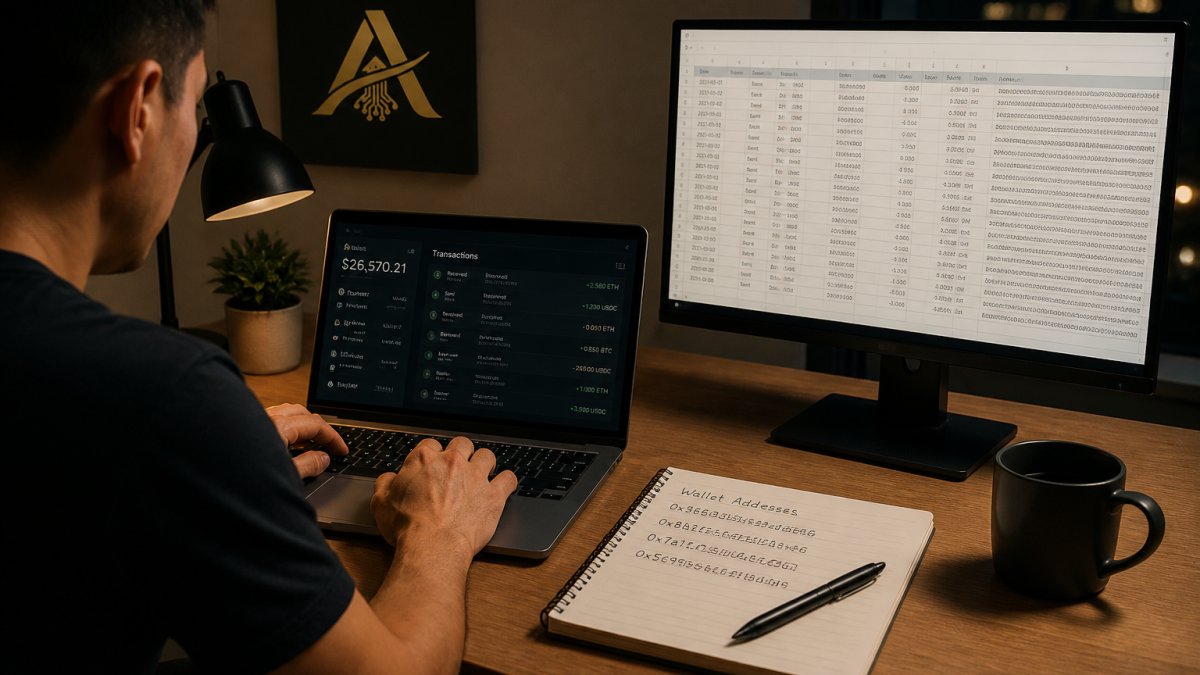
Organize the data into one master sheet. Include these columns:
- Date and time of each transaction
- Wallet or platform involved
- Type of activity (swap, reward, deposit, withdrawal)
- Token amounts in and out
- Fair market value at the time
Step 2: How to Calculate Crypto Gains and Losses From DeFi Activity
To calculate a gain or loss, subtract your cost basis from your proceeds. Basis is what you paid to acquire the asset, including certain acquisition fees. Proceeds are what you received when you disposed of it.
The result is a realized gain or realized loss. Gains add to your taxable income. Losses can offset gains, within the rules.
Cost Basis, Proceeds, and Fair Market Value
Cost basis includes what you originally paid, plus certain fees. Proceeds are the fair market value of whatever you received in the swap or sale.
Fair market value is the price the asset would sell for on the open market at that moment. For crypto, that usually means the price on a major exchange at the transaction time.
Keep basis records for every token you hold. If you acquired the same token at different prices, you also need a consistent method for deciding which units you sold, first-in, first-out is the default, and specific identification is allowed when you identify the units at the time of the sale. Since January 1, 2025, this is tracked separately for each wallet and account.
Cross-Chain Activity, Bridges, Wrapped Tokens, and Gas Fees
Moving assets between chains is where reporting gets tricky. Here is how the common patterns usually sort out.
Bridge transfers. Sending a token from one chain to another through a bridge is often treated as a transfer, not a disposal, when you end up with a claim on the same asset, though the IRS has not issued specific guidance on bridges.
Wrapped tokens. Wrapping is less clear-cut. If you deposit ETH and receive an equivalent wrapped ETH that tracks the same value one-to-one, many treat it as a transfer; others treat it as a swap. The IRS has not addressed wrapping directly, so pick a position, document it, and apply it consistently.
Gas fees. Gas is part of your cost. Fees paid to acquire an asset generally add to basis, and fees paid to dispose of an asset generally reduce proceeds.
Recordkeeping for cross-chain moves. For every bridge or wrap, capture:
- The source chain, destination chain, and bridge or wrapper used
- The token and amount sent, and the token and amount received
- The fair market value on both sides at the time of the transaction
- The gas fee paid, in the native token and in dollars at that moment
- A short note on whether you treated it as a transfer or a disposal, and why
For cross-chain moves, record the value on both sides of the bridge. If the amounts match, it is likely a transfer, not a disposal. If they differ, the difference may be a taxable event. Save the transaction hash for each leg so you can trace the path later.
Handling Missing, Incomplete, or Conflicting Records
On-chain data is messy. Prices are missing for obscure tokens, timestamps conflict between sources, and a bridge may show a debit on one chain and a credit on another with no link between them.
$95 Crypto Review. Non-refundable. Fully credited toward your engagement if signed within 30 days.
Here is how to handle the gaps:
- Fill missing prices from a reliable historical price source, and note which source you used
- Reconcile conflicts by trusting the blockchain record over a third-party app
- Match bridge legs by transaction hash and wallet address so you do not double-count a transfer as a sale
- Flag any transaction you cannot value, and document your reasoning
- Keep a note of every assumption you make
Documentation matters. If a figure is ever questioned, your notes show how you arrived at it. A short assumptions log, one line per judgment call, can be helpful for a clean review.
Liquidity Pool Tax Reporting: Deposits, Withdrawals, and Impermanent Loss
Liquidity pool tax reporting depends on what you contributed and what you got back. The IRS has not issued specific guidance on liquidity pools. Some treat a deposit as a non-taxable transfer because you still own a claim on the assets; many treat exchanging tokens for LP tokens as a taxable exchange. Whichever position you take, document it and apply it the same way every time.
Withdrawing is different. If you receive a different mix or amount of tokens than you deposited, that difference can create a gain or loss.
Impermanent loss is the gap between what your tokens would be worth if you had held them versus what they are worth in the pool. It isn’t a separate deduction; it shows up in the value you receive when you withdraw.
Track each pool separately. Record your deposit value, your withdrawal value, and any rewards earned along the way.
DeFi Tax Forms: What Goes on Form 8949, Schedule D, and Schedule 1
Most DeFi capital gains and losses land on Form 8949 and carry to Schedule D. Ordinary income from rewards typically goes on Schedule 1 as other income.
Here is how the pieces fit together:
| Activity | Tax Treatment | Where It Goes |
|---|---|---|
| Token swaps and sales | Capital gain or loss | Form 8949, then Schedule D |
| Staking and farming rewards | Ordinary income at receipt | Schedule 1 |
| Liquidity pool withdrawals | Capital gain or loss | Form 8949, then Schedule D |
| Self-employment style income | Ordinary income | Schedule C, Schedule SE |
Form 8949 lists each disposal with its date, proceeds, and basis. Schedule D totals your gains and losses. The net result flows to your Form 1040.
The IRS has also introduced Form 1099-DA for reporting digital asset transactions by certain brokers. Not every DeFi platform issues one, so your own records are important.
Using Crypto Tax Software for DeFi Reporting
Crypto tax software can pull wallet data and calculate gains automatically. It saves time, but it is not a magic fix.
The tools work best when your data is clean. Gaps and conflicts still need a human to sort out, and software struggles with newer DeFi activity its rules do not yet cover.
A practical approach:
- Import your wallet and exchange data
- Review every flagged or unmatched transaction
- Manually correct missing prices and mislabeled types
- Export the summary for your return
Software handles the math. You still own the judgment calls. When the cleanup itself is the bottleneck, a Crypto Bookkeeping & Reconciliation service can organize wallet activity into reconciled records you can hand to whoever prepares the return.
A Transaction-by-Transaction DeFi Reporting Walkthrough
Here is how one year of DeFi activity comes together, using a simplified example.
The scenario. You start the year with 2 ETH you bought earlier for $3,000 total. Over the year you:
- Swap 1 ETH for a stablecoin on a decentralized exchange
- Stake the stablecoin and earn rewards
- Deposit tokens into a liquidity pool and later withdraw
- Bridge some tokens to another chain
Step 1: List every wallet. Write down each address you used, including any you abandoned.
Step 2: Export each history. Pull CSVs from wallets and block explorers.
Step 3: Combine into one sheet. Merge everything into a single master file. Sort by date and time.
Step 4: Tag each transaction. Label it swap, reward, deposit, withdrawal, bridge, or wrap.
Step 5: Calculate gains and losses. Subtract basis from proceeds for each disposal.
Step 6: Separate income from gains. Move reward income to its own total.
Step 7: Map to forms. Place each disposal on Form 8949 with its date acquired, date sold, proceeds, and basis.
The single most important habit is consistency. Reconcile your DeFi activity monthly or quarterly, not once in April. Organized records can help make filing more routine, and they can make it easier to answer questions if the return is ever reviewed.
Frequently Asked Questions
Are DeFi swaps taxable events?
Yes. Swapping one token for another is treated as a disposal of the token you give up, so you realize a capital gain or loss on its change in value since you acquired it. The new token starts with a fresh cost basis equal to its fair market value at the time of the swap. This is why you report DeFi swaps on Form 8949 and Schedule D rather than treating them as simple transfers between your own wallets.
How are staking and liquidity pool rewards reported?
Staking, yield farming, and liquidity pool rewards are generally reported as ordinary income at the fair market value on the date you receive them. That value becomes your cost basis in the tokens, so you do not pay tax twice when you later sell. Depending on the activity, the income may belong on Schedule 1 or Schedule C, and self-employment tax may apply if it looks like a trade or business.
What should I do if my DeFi transaction history is incomplete?
Start by pulling records from every source you can: wallet exports, exchange statements, block explorers, and any tax software you have used. Rebuild missing cost basis using the earliest reliable price data you can document. Keep a written note explaining each gap and how you filled it. Complete records matter because the burden of proving basis and holding period falls on you if questions come up later.
How do I report DeFi activity if I used multiple wallets?
Report all of your wallets on one return, but track cost basis wallet by wallet: since January 1, 2025, basis is tracked separately for each wallet and account. Transfers between your own wallets are not taxable, but every swap, sale, and reward is. Consolidate the transaction history from each wallet into a single ledger, label internal transfers so they are not double-counted, and reconcile the totals before you calculate gains. This is where crypto bookkeeping and reconciliation services can save hours of manual cleanup.
$95 Crypto Review. Non-refundable. Fully credited toward your engagement if signed within 30 days.